Surface Wave Mode
Generate surface-wave-dominated virtual shot gathers from continuous ambient noise recordings. Surface waves carry rich information about shallow to intermediate crustal velocity structure, making them ideal for basin mapping and receiver function studies.
- High-coherence Rayleigh & Love wave extraction
- Optimized for shallow-to-intermediate depth imaging
- Ideal for basin structure and sedimentary thickness mapping
- Direct input for receiver function analysis
- Frequency-wavenumber (f-k) filtering for mode separation
- Adaptive stacking for enhanced signal-to-noise ratio
Reflection Wave Mode Signature
Our signature capability — extract high-quality body-wave reflections from passive-source ambient noise. By suppressing the dominant surface wave energy and enhancing weak reflection arrivals, DeepSeis produces virtual shot gathers that rival active-source data. The same workflow covers the full depth spectrum: from near-surface structures (upper crust) to lithospheric-scale features including the Moho discontinuity.
- Passive-source reflection extraction — no explosives or vibrators needed
- Near-surface imaging: upper crustal velocity structure, sedimentary layer interfaces, shallow fault systems
- Lithospheric imaging: Moho discontinuity, lithosphere-asthenosphere boundary (LAB), deep crustal reflectors
- Body-wave / surface-wave separation in f-k domain
- Directional energy balancing to suppress noise anisotropy
- NMO-CMP stacking for reflection profile generation
- SEG-Y export compatible with standard interpretation software
Intuitive GUI Interface
Complete desktop application with visual data preview, mode selection (Surface Wave / Reflection Wave), parameter tuning, and real-time result display. No command-line expertise needed.
- Visual raw data preview with 99% amplitude clipping
- Real-time result display with virtual shot navigation
- 7 colormap options (bone_r, seismic, RdBu_r, viridis, jet, etc.)
- Parameter tuning with instant visual feedback
- Background task queue with progress tracking
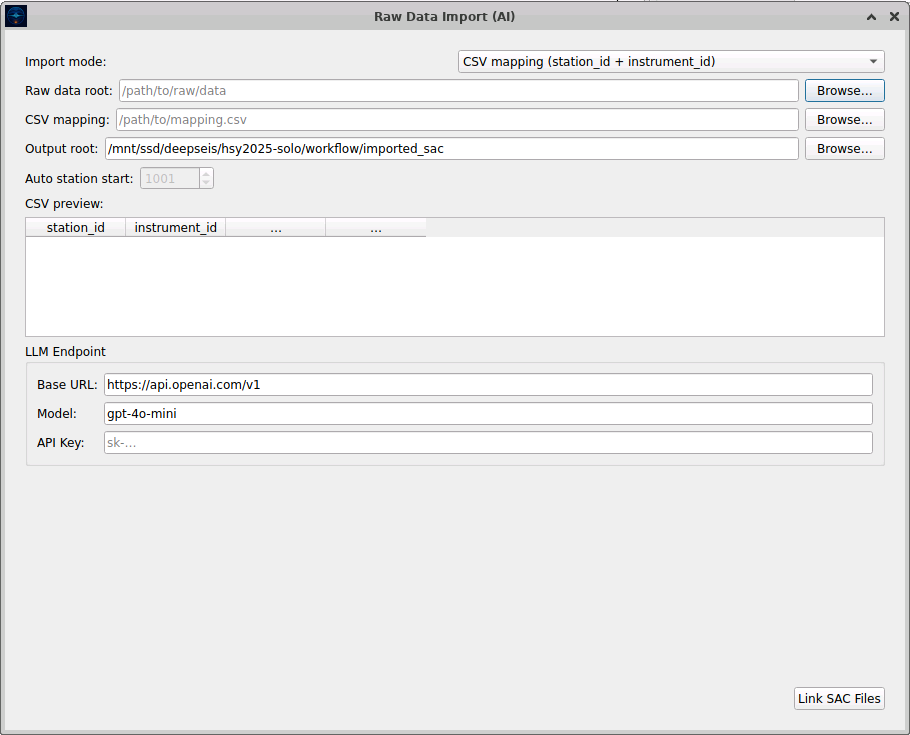
Multi-Format Data Support & AI Import
Load your data directly without format conversion. DeepSeis handles SEG-Y, MATLAB .mat, and SAC directory formats — with AI-assisted station mapping via LLM to automate metadata extraction from complex directory structures.
- SEG-Y: Full IBM/IEEE float support via segyio
- MATLAB: Direct .mat file reading with h5py
- SAC Directory: Auto-discovery of nested date/station structures
- AI Import: LLM-powered CSV mapping for station_id + instrument_id
- Manifest caching for instant reload of TB-scale datasets
- Automatic station metadata extraction from SAC headers
AI-Assisted Quality Control
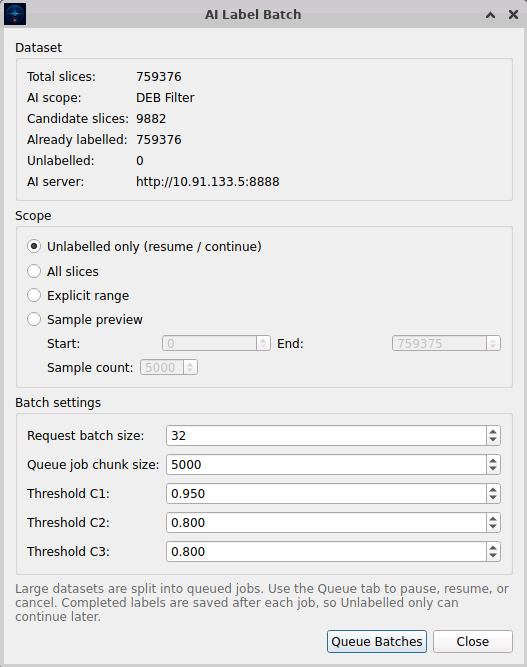
Automated quality classification using FK-domain spectral features and waveform analysis. Batch-label hundreds of thousands of slices with configurable confidence thresholds — what used to take weeks of manual review now takes hours.
- Local FK spectrum + waveform feature extraction
- Batch labeling with configurable confidence thresholds (C1/C2/C3)
- Visual slice review with colormap switching
- Manual label override and refinement
- Label-based slice filtering for cross-correlation input
Directional Energy Balancing (DEB)
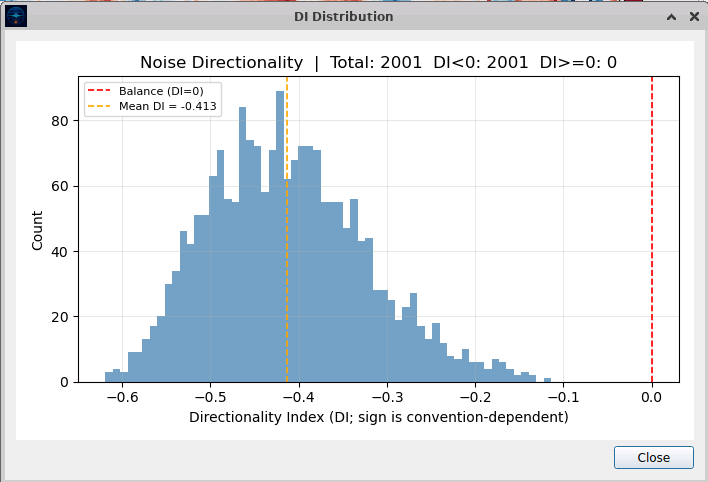
FK-domain directional filtering suppresses dominant noise energy while preserving signal across all azimuths for cleaner Green's function estimates. Visualize noise directionality with DI histograms and scatter plots — identify and filter problematic panels before cross-correlation.
- Directional Index (DI) scanning across all panels
- DI histogram and panel scatter plot diagnostics
- Configurable DI filter thresholds (Balance line, Mean DI)
- Review cross-correlation input after DEB filtering
- Preserves signal energy across all azimuths
Cross-Correlation Engine
Frequency-domain cross-correlation with adaptive stacking windows. Full station-pair management and progress tracking built in.
- Multi-threaded background processing
- Real-time virtual shot preview in Result tab
- Virtual shot navigation with Prev/Next and dropdown
- Configurable stacking windows and parameters
- Positive/negative lag merging for symmetric results
NMO Stack & Export
Normal-moveout stacking with CSV-based receiver geometry. Export results as SEG-Y for further interpretation or as images for publication.
- CSV-based coordinate input for flexible deployment
- Velocity scanning and constant velocity modes
- Stretch mute (SU smute / relative stretch)
- FK velocity cut, taper, and bandpass filtering
- Export as SEG-Y, PNG, or PDF
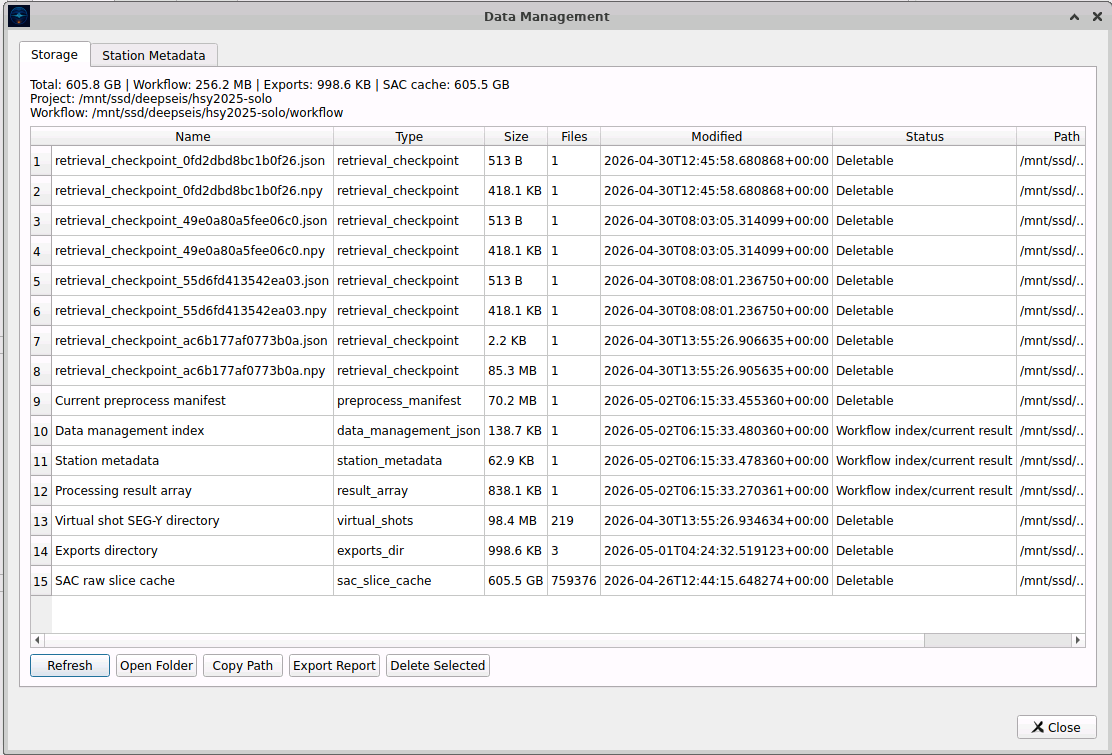
Data Management & Storage Monitoring
Full visibility into your TB-scale processing pipeline. Track every file — checkpoints, manifests, virtual shots, exports, and raw slice caches — with one-click deletion, path copying, and export reporting. Manage hundreds of gigabytes of seismic data with confidence.
- Real-time storage breakdown: Workflow, Exports, SAC cache
- File-level management: retrieval checkpoints, result arrays, virtual shot directories
- One-click actions: Refresh, Open Folder, Copy Path, Export Report, Delete Selected
- Station metadata tab for receiver geometry review
- Automatic manifest and index tracking for reproducibility
- Handles 600+ GB raw slice caches with 750K+ files